
Many Irish school buildings were wired for a world that had no concept of heat pumps, rooftop photovoltaics, or the metering infrastructure now needed to verify performance under current energy standards.
That matters because on education retrofit projects, the electrical scope is rarely the glamorous conversation until it becomes the critical path item that stalls procurement, site sequencing, or practical completion.
For Architects and main contractors working across education projects, early input from an experienced MEP design consultant is not just good practice. It is what turns an upgrade brief into a buildable, compliant, properly sequenced delivery plan.
Retrofitting an educational facility is not a straightforward refurbishment. It has to satisfy energy performance targets, technical guidance, statutory obligations, and the operational realities of working in a live or semi-live school environment.
In practice, the electrical scope on a typical school retrofit now includes six core workstreams:
Get those six areas right early and the project team has a coordinated technical basis for tender, sequencing, and delivery. Get them wrong and the job tends to unravel late.
An MEP design consultant sits between the architect's intent, the contractor's programme, and the constraints of the existing building. In school retrofit work, that role is particularly demanding because the existing asset is rarely as simple as the drawings suggest.
A good retrofit process starts with a hard-nosed assessment of what is already there:
That last point is critical. Many older school buildings contain legacy cabling and distribution infrastructure that may still be serviceable in part, but only if it is properly surveyed, tested, and assessed before the design is fixed. A comprehensive survey is required to understand the impact of the proposed retrofit works on the existing LV and ELV systems, reducing the risk of scope growth and programme delays after commencement.
The consultant also has to model future load demand, coordinate clashes across disciplines, and align the electrical strategy with building control, certification, fire, and operational requirements. That now includes reviewing how BMS updates will maintain occupant comfort, improve energy performance through the control strategy, and support sensible interfacing with the fire alarm system.
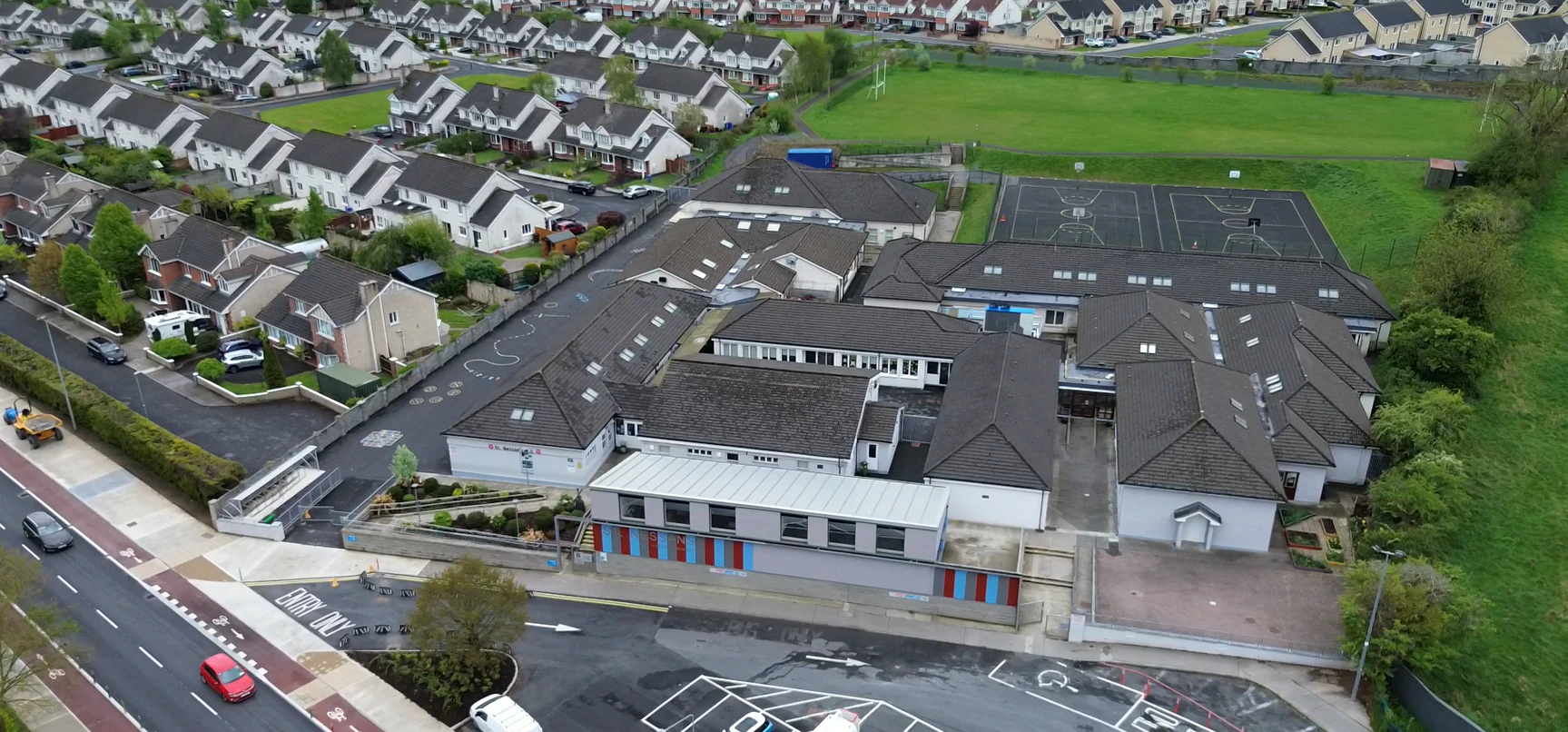
Pictured above: St. Nessan's National School, Mungret, Co. Limerick. Part of the visionary Pathfinder Programme by SEAI & Department of Education. This initiative is paving the way for energy-efficient retrofits in schools across Ireland.
LED lighting remains the most visible part of a school retrofit and the one most likely to be underspecified. A proper upgrade is not just a fixture replacement exercise.
When designed properly, LED upgrades can deliver major energy savings and a noticeably better learning environment. When designed poorly, they create compliance gaps, operational complaints, and expensive late-stage revisions.
One of the most programme-sensitive tasks in a school decarbonisation retrofit is the ESB maximum import capacity review. Heat pumps change the building's electrical profile materially, and older intakes often cannot absorb that increase without an upgrade.
This is exactly the kind of issue that needs to be identified at the front end. If it is discovered too late, it lands directly on the delivery programme with very few options left.
Rooftop PV is now a standard feature on many education retrofit schemes, but its value depends on the quality of the electrical design behind it.
Metering matters just as much as generation. Without a robust metering strategy, the project team cannot clearly verify imported load, generated energy, or the actual effect of the retrofit measures over time.
Teams that work regularly on older education buildings will recognise the same failure points appearing again and again, particularly where the survey of existing LV and ELV systems has been too light-touch to define retained assets, coordination constraints, and integration requirements with confidence:
Experienced MEP teams reduce these risks by getting into the building early, testing assumptions hard, and defining the retention-versus-replacement strategy before the design is frozen.
The most expensive point to discover an electrical constraint is after the brief is fixed and the programme is already under pressure.
For school retrofit projects, early-stage MEP involvement gives the team a realistic view of load growth, infrastructure condition, retained asset viability, and the true risk of hidden rewiring scope.
That is where the value is. Not in producing another set of drawings, but in helping the team avoid avoidable surprises and deliver an upgrade that is technically sound, commercially controlled, and genuinely buildable.
Gareth joined EDC in 2015 as a Senior Engineer, following a successful 3-year tenure at Hoare Lea in Manchester. A graduate of Dublin Institute of Technology in 2012, Gareth holds a B.Sc. (Hons) in Electrical Services and Energy Management. His engineering acumen is complemented by extensive practical experience as a seasoned electrician, successfully navigating intricate industrial electrical projects.
With a diverse technical skill set, Gareth’s expertise spans an extensive range of market sectors, including residential, industrial, student residential, and commercial offices. His extensive project management portfolio includes notable projects such as the North City Operations Depot, Bombardier Energy from Waste Facility, Rathdown Road Student Accommodation, Guinness Enterprise Centre, and Carechoice Nursing Homes.
Gareth assumed the role of Associate Director in 2021, and then the role of Executive Director in 2024. In this capacity heads up the Dublin office in addition to orchestrating the design and coordination of electrical services from project inception to completion. Gareth’s commitment to excellence and hands-on approach underscores his invaluable contribution to EDC.