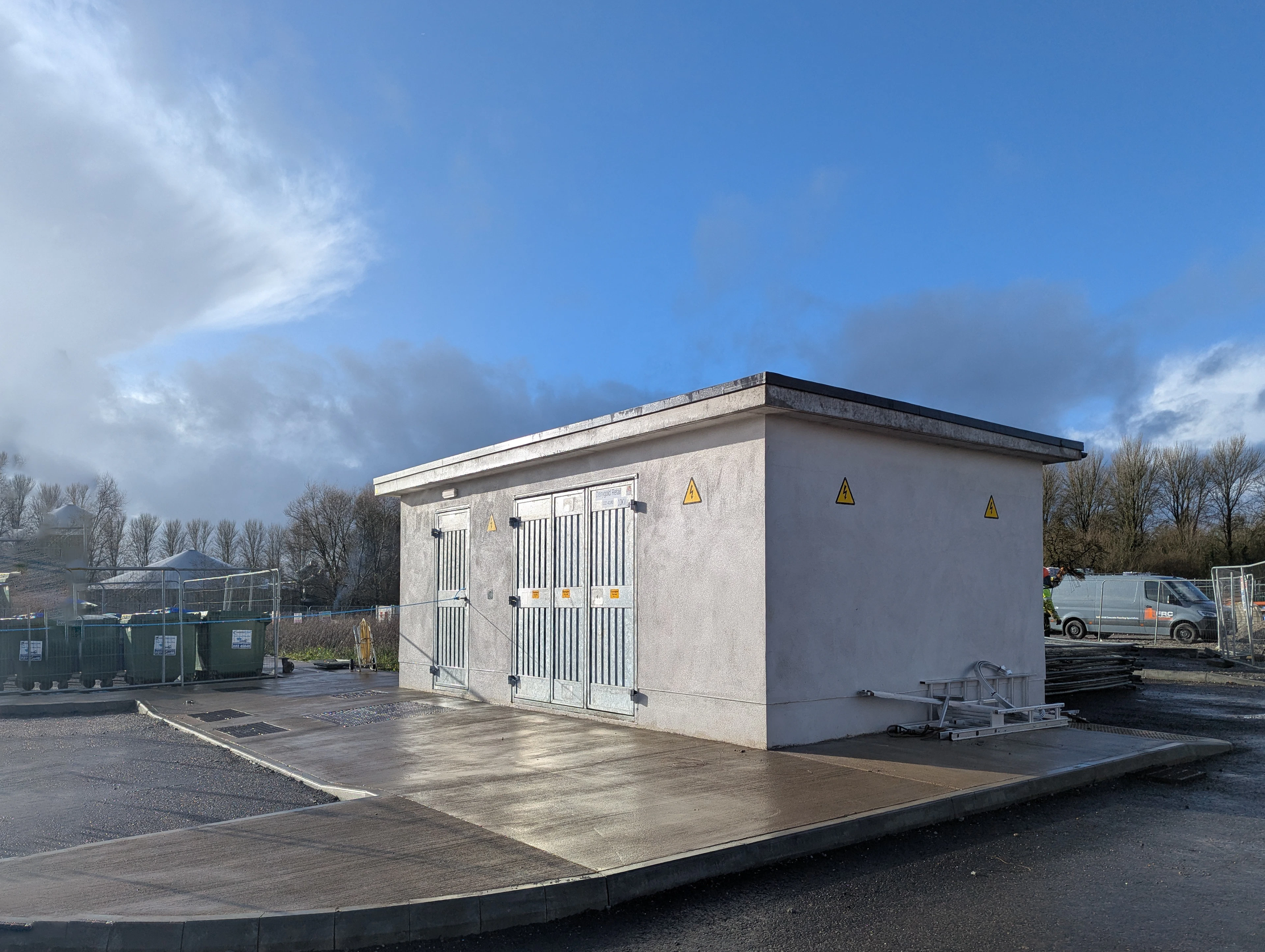
An ESB Networks substation isn’t just another line item on a drawing. It is critical infrastructure and on many Irish developments, it becomes a defining design constraint.
Whether you’re delivering Residential schemes in Dublin, a mixed-use scheme in Cork, or a logistics facility in Galway, understanding ESB substation requirements early can prevent redesign, planning delays, and programme risk.
This checklist sets out the practical realities developers need to know.
An ESB Networks substation transforms medium-voltage electricity to lower voltages suitable for safe distribution to homes, commercial units and industrial loads. It also manages switching, protection and grid stability.
For high electrical demand schemes, ESB substation is often mandatory.
The key trigger is the Maximum Import Capacity (MIC).
If this is not carefully considered during the concept and design stages, it could lead to avoidable redesign work, and potential implications to current granted planning applications.
The Early Checks
Before finalising layout:
Local grid constraints can influence whether a substation is required even where load appears modest.
2. Confirm Your Maximum Import Capacity (MIC)
Your MEP consultant must calculate MIC accurately based on:
3. Review Your Connection Agreement
Your ESB Networks Connection Agreement / Quotation Letter will confirm:
Do not rely on assumptions. Always revert to the quotation documentation.
4. Substation Design & Planning Requirements
A single ESB MV substation is typically required when:
Important: Even where MIC is ≤ 200 kVA, a substation may still be required depending on local network capacity. Final determination rests with the appointed ESB Engineering Officer.
Early engagement is a must with the local ESBN engineering department.
A double MV substation is typically required when:
On larger apartment or mixed-use schemes, this is increasingly common due to heat pumps, EV charging and electrification strategies.
When is a ESB Substation Required for a Commercial/ Industrial/ Healthcare building?
A MV substation is typically required when:
The MV switchroom must be adjacent to the ESB substation. On Commercial, Industrial and Healthcare schemes, this is increasingly common due MIC load requirements.
Clearance issues regularly cause redesign. Key restrictions include:
⛔ Substation doors must not be within 3 m of:
⛔ Windows within 3 m of the door:
⛔ Substation doors must not be within 5 m of:
⛔ Small single-room apartment air vents within 3 m:
**These rules are non-negotiable.
Location Matters
Developers often lose valuable ground-floor frontage because this isn’t considered early enough in the design process.
Apartments – “Substation Per Block” Guidance
On apartment schemes:
No Underground Car Park
With Underground Car Park
Poor coordination here can severely impact basement layouts.
Unimpeded 24-Hour Access
ESB Networks requires:
If access is compromised, connection can be delayed.
Site Transfer & Legal Requirements
Before energisation:
Legal delays regularly hold up energisation involve solicitors early.
For Demolition of Existing ESB Substations
This is particularly relevant on brownfield urban sites.
The biggest mistake we see?
Treating the ESB substation as a late stage compliance item rather than a core design constraint.
Substation size, access, fire separation, and legal transfer requirements can materially impact:
On high density Irish developments, early MEP input is not optional. It is risk management.
Peter is an Associate Director in our Dublin office and has been working in the construction industry since 1996. He is an experienced building services design professional with extensive project exposure across Ireland and the Middle East. Over nearly three decades, he has developed a broad skill set spanning planning, design, consultancy, project management, commissioning, and maintenance.
His portfolio includes work across multiple sectors, including education, commercial, pharmaceutical, healthcare, public, food, retail, and data centres. Peter’s technical expertise covers electrical design, value engineering, construction management, commissioning management, sustainable design, auditing, and implementation.
Throughout his career, Peter has contributed within multidisciplinary teams and has also supervised junior engineering and CAD staff on a range of projects. He has taken responsibility for developing budget costs, preparing tender specifications, producing electrical design drawings, and completing tender analysis reports. On site, he has overseen inspections of electrical services installations and, upon project completion, has led snagging processes, system demonstrations, commissioning activities, and reviews of operation and maintenance manuals.